The Court doesn’t always make good decisions. But when they do, it’s huge.
And now the Supreme Court just slammed the door on one Democrat plot.
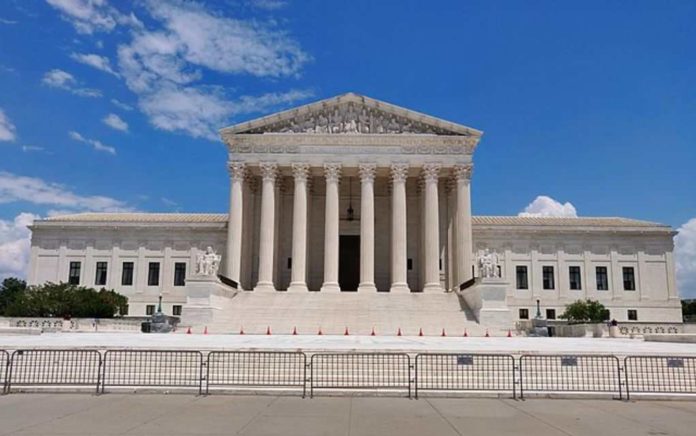
The Supreme Court delivered a measured and principled ruling on March 2, 2026, granting an emergency stay that preserves New York’s existing congressional map for the 2026 elections, halting a lower state court order that would have forced a redraw of the 11th Congressional District to prioritize racial considerations.
This decision, issued by the Court’s conservative majority over the dissent of the three liberal justices, reaffirms the Constitution’s commitment to colorblind equality under the law and prevents last-minute judicial interference in elections.
At issue was New York’s 11th District, which encompasses Staten Island and parts of southern Brooklyn and is currently represented by Republican Rep. Nicole Malliotakis—the only GOP-held congressional seat in New York City.
In January 2026, New York Supreme Court Justice Jeffrey Pearlman ruled that the district unlawfully diluted the voting power of Black and Latino residents under the state constitution, ordering the Independent Redistricting Commission to redraw lines to create a “crossover” district enabling minority voters to more reliably elect their preferred candidates.
Court’s Firm Stand Against Race-Based Redistricting
In an unsigned order, the Supreme Court granted the stay requested by Malliotakis, state election officials, and others, blocking the redraw while litigation continues.
Justice Samuel Alito, in a concurring opinion, sharply critiqued the lower court’s directive as “blatantly discriminat[ing] on the basis of race,” describing it as “unadorned racial discrimination” that violates the Fourteenth Amendment’s Equal Protection Clause except in the “most extraordinary case.”
He emphasized that the order aimed at ensuring minority voters could “elect the candidate of their choice” constituted impermissible racial gerrymandering absent compelling justification for past discrimination.
Alito further invoked the Court’s recent precedent in
Students for Fair Admissions v. Harvard
(2023), stressing that race-based government actions require extraordinary circumstances and cannot be justified by broad notions of “vote dilution.”
He warned of the risks posed by the
Purcell
principle—avoiding election-rule changes close to voting—noting that judicial interventions even months before an election can disrupt the process.
The majority’s action signals a broader skepticism toward state-court efforts to mandate race-conscious redistricting under the guise of fairness, protecting against what critics view as reverse gerrymandering that could dilute votes based on race.
Liberal Dissent and Broader Implications
The Court’s three liberal justices—Sonia Sotomayor, Elena Kagan, and Ketanji Brown Jackson—dissented, arguing that the stay thrust the Court into routine election disputes and could invite endless challenges to state redistricting.
Sotomayor wrote that the decision might open the door to federal intervention in “every election-law dispute around the country,” even as states adjust maps ahead of 2026.
Malliotakis praised the outcome, stating it “helps restore the public’s confidence in our judicial system” and proves the challenge was “meritless” and “unconstitutional.” The ruling allows elections to proceed under the legislatively enacted map, providing stability for voters and candidates in a competitive district.
It may also influence similar battles in other states, reinforcing the principle that redistricting should prioritize neutral criteria over explicit racial targets.
This decision upholds the Supreme Court’s role as a guardian of constitutional limits, ensuring that electoral maps reflect fair, non-discriminatory principles rather than judicially imposed racial quotas.