
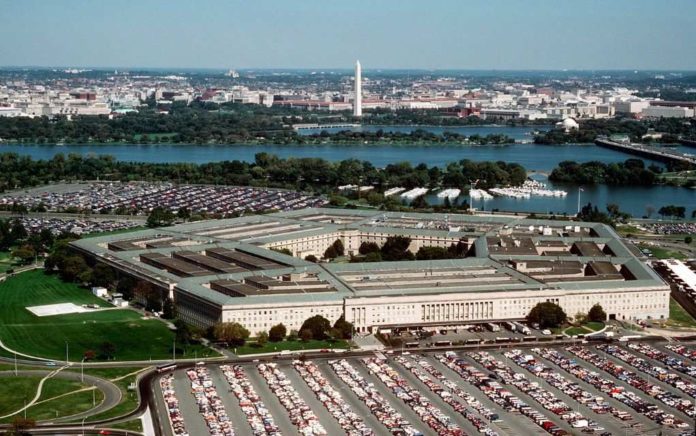
America’s soft belly is showing. And there’s no telling if her enemies will strike.
Because an alarming report exposed an awful weakness plaguing the US military.
China on Wartime Footing: U.S. Could Exhaust Missile Stocks in “Roughly a Week” Over Taiwan
In his new book The American Edge, CSIS defense chief Seth Jones delivers a stark verdict: “The U.S. struggle with China is the single greatest competition the United States has ever faced.”
Speaking to Fox News Digital, the former Pentagon official warned that in a Taiwan conflict, America’s inventory of long-range precision missiles would likely be depleted “after roughly a week or so of conflict.” That alarming shortfall, he says, reveals how far the U.S. defense industrial base has fallen behind Beijing’s all-out production surge.
“When you look at the numbers right now of those long-range munitions, we still right now would run out after roughly a week or so of conflict over Taiwan,” Jones said. “That’s just not enough to sustain a protracted war.”
The Production Gap: China Builds 230 Times Faster Than the U.S. at Sea
Unlike the economically isolated Soviet Union, China’s GDP rivals America’s and is tightly woven into global supply chains—fuel that is powering what Jones calls an unprecedented military expansion. Beijing’s shipyards alone are “upwards of 230 times the size of the United States,” while its missile arsenal is specifically engineered to push U.S. carriers and aircraft beyond striking range of Taiwan.
Yet Jones highlights one persistent Chinese weakness: anti-submarine warfare. Beijing “still can’t see that well undersea,” giving U.S. attack submarines—and a coming wave of unmanned underwater vehicles—a potentially decisive edge in any cross-strait fight.
He also notes corruption in the PLA, inefficiencies in state-owned defense giants, poor joint-warfighting skills, and the lack of recent combat experience since 1979, and limited power-projection beyond the First Island Chain. Still, none of those flaws alter the central reality: “The gap is shrinking.”
Trump Pushes “Wartime Footing,” But Jones Says It’s Still Trench Warfare
Jones argues that great-power wars are ultimately won by production capacity, not just technological brilliance—and that is where America is most vulnerable. Aging shipyards, endless acquisition timelines, and a bureaucracy not built for mass output have left the U.S. struggling to keep pace.
He applauds the Trump administration’s new language and actions—rapid-acquisition offices, multiyear munition buys, and drone-focused initiatives—but warns the reforms are only scratching the surface.
“That is exactly the right wording,” Jones said of the phrase “wartime footing.” “The Chinese and the Russian industrial bases right now … are both on a wartime footing.”
“The Pentagon writ large is a massive bureaucracy,” he added. “It’s going to take a lot to break that bureaucracy. There’s been some progress, but it’s trench warfare right now.”
Jones calls for Cold-War-level spending (closer to 5–6 percent of GDP instead of today’s roughly 3 percent), deeper use of allied shipyards in Japan and South Korea, and a reversal of 1990s-style defense-industry consolidation. On artificial intelligence, he insists the Pentagon must pull commercial giants like Nvidia and Google directly into classified programs, warning: “You can’t do things like air defense now without an increasing role of artificial intelligence.”
Despite the grim outlook, Jones believes the window to regain the American edge remains open—but only if Washington treats China’s wartime mobilization as the five-alarm fire it is. “The Trump administration is talking about a wartime footing,” he concluded. “China is already living it.”