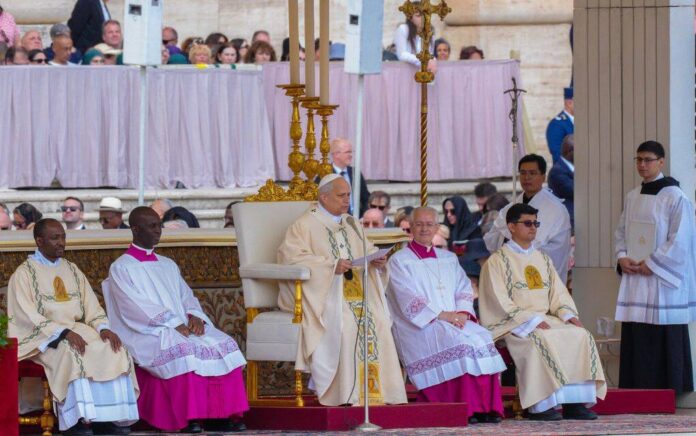
The first American Pope is shaking things up. And not everyone knows how to take it.
Because Pope Leo XIV threw Donald Trump for a loop with one major announcement.
The Vatican has opted out of participating in President Donald Trump’s newly established Board of Peace, an initiative focused on Gaza’s post-conflict recovery and reconstruction.
Vatican’s Decision and Rationale
Cardinal Pietro Parolin, the Vatican’s Secretary of State, announced that the Holy See “will not participate in the Board of Peace because of its particular nature, which is evidently not that of other States.”
He expressed that certain aspects leave the Vatican “somewhat perplexed” and require further explanations, noting “there are some critical points that should be resolved.”
Parolin stressed the importance of multilateral approaches, stating: “at the international level it should above all be the UN that manages these crisis situations,” and described this as “one of the points on which we have insisted.”
Details of the Board of Peace Initiative
The Board of Peace was chartered in January 2026, with a signing ceremony in Davos, Switzerland, involving leaders from nearly 20 countries across Latin America, Europe, the Middle East, and Asia.
Israel formally joined last week ahead of Prime Minister Benjamin Netanyahu’s White House meeting with Trump.
Trump has described it as advancing with pledges exceeding $5 billion in aid for Gaza, with a formal gathering planned in Washington, D.C.
The initiative originated as part of efforts to oversee Gaza’s recovery following the Israel-Hamas conflict and a subsequent ceasefire, though its scope has drawn varied international responses.
Broader Reactions and Context
The Vatican’s refusal aligns with decisions by other nations, including Poland and Italy, which also declined to join.
While the board has secured commitments from several countries and highlighted significant pledged funding, concerns about its structure—particularly its U.S.-led nature and potential overlap with established international bodies like the United Nations—have prompted hesitation from some invited parties.
The move reflects ongoing debates about the most effective frameworks for addressing humanitarian and reconstruction needs in Gaza amid a fragile post-war environment.