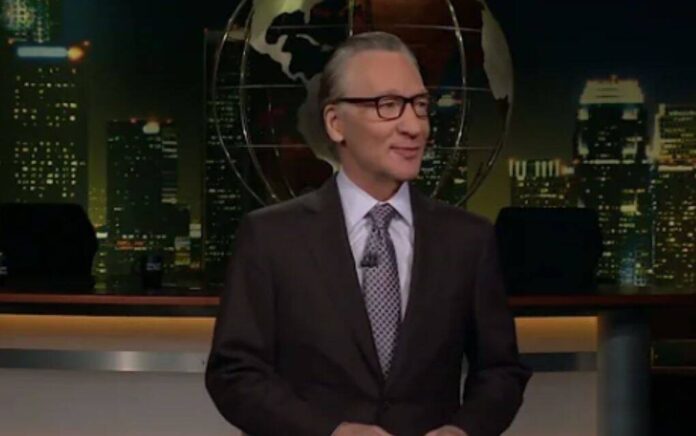
Maher is losing his patience. And the Left can’t stand it.
Now Bill Maher betrayed his own party in a huge statement you can’t miss.
The Diagnosis From The Left’s Most Useful Critic
Bill Maher says he voted for Kamala Harris. He says it directly, without qualification, on his own podcast, in the same breath where he explains why he blames the progressive wing of her party for her loss. That combination — liberal voter, liberal-party critic — is what gives his commentary unusual credibility in the current moment. He is not a conservative complaining about Democrats. He is a Democrat explaining, with increasing candor, why his party keeps losing people it cannot afford to lose.
On Monday’s episode of “Club Random,” talking with rapper will.i.am, Maher was asked which interview subjects he has not yet landed but would most want to sit with. His answer was pointed.
“Ironically, mostly Democrats, like, because they’re such p—ies, they won’t come on the show,” Maher said. “Like the Clintons, I mean, you know, Kamala, I voted for you.”
The Clintons and Harris have declined to appear on “Real Time with Bill Maher” despite Maher’s consistent, vocal support for their political goals. The reason, in Maher’s diagnosis, is structural cowardice: “Democrats are p—ies about, like, going anywhere that they’re not already pre-adored. Not all of them, but I mean, somebody [like] Kamala Harris — I mean, like I always say to my woke friends, we voted for the same person. You’re just why she lost.”
It is one of the sharpest encapsulations of the Democratic Party’s media pathology offered by anyone currently working in political commentary.
Pre-Adored: What The Word Actually Means
The phrase “pre-adored” does a lot of work. What Maher is describing is not mere caution or a preference for friendly interviewers — it is a structural refusal to engage with any audience that might produce friction. Democratic politicians, in Maher’s telling, have calibrated their media diet to include only venues where their positions will be celebrated, their challengers dismissed, and their self-image reflected back to them as heroes.
The practical consequence is that a party claiming to speak for all Americans has increasingly built its entire public communication infrastructure around institutions — MSNBC (now MS NOW), late-night television, progressive podcasts, university lecture circuits — where audiences agree with them before they open their mouths. When they leave those environments, they are visibly uncomfortable. When they are asked genuine follow-up questions, they stumble. When they are confronted by voters who don’t already love them, they have no language for the encounter.
Harris’s 2024 campaign illustrated this precisely. She did not do a broad general-audience press conference for months. She avoided venues where her record on the economy might be probed seriously. Her campaign’s media strategy was built around protecting her from adversarial questions rather than demonstrating she could answer them. For a candidate trying to win over working-class voters who were skeptical of her, that approach was strategically backward — and Maher, a liberal who voted for her, is saying it plainly.
The Fringe Problem — And The Obama Baseline
Maher’s deeper diagnosis on the podcast goes beyond media strategy to what he sees as the philosophical capture of the party by its progressive fringe. He argued that both parties are driven by their extremes, but that the left’s fringe has been particularly effective at using social media and cultural institutions to enforce ideological conformity.
“What you have to mainly understand about political parties is that they’re controlled by their fringes,” he told will.i.am. “The people on the fringes — they have the megaphone, especially on the left… Younger people on both sides are much more radical, and they’re better at social media. They’re better at media. They’re better at getting attention.”
He offered Barack Obama as the standard against which current Democratic leadership falls short — specifically praising Obama as “the ultimate pragmatist.” That framing is interesting from a conservative perspective, because Obama’s pragmatism was always more stylistic than substantive, but it captures something real: Obama could speak to audiences that were skeptical of him without losing his footing, adjust his messaging to different rooms, and project a convincing universality even when his actual policies were firmly left-of-center. The current generation of Democratic leadership, Maher is arguing, lacks that skill — and perhaps more importantly, lacks the willingness to develop it, because their media ecosystem doesn’t require it.
From a conservative vantage point, the irony is considerable. The party that accuses Fox News of operating in an information bubble has constructed one far more insular — where a Democratic comedian with a left-of-center show can’t get the Clintons or Kamala Harris to appear because even that room isn’t safe enough. If the leaders of the Democratic Party won’t go anywhere they aren’t pre-adored, the voters they’re asking to return their calls are paying attention.