
The courts rarely help out the conservative cause. But this time is different.
Now a federal court hands Republicans a massive win with a huge ramifications for America.
A SWEEPING RULING THAT COULDN’T BE IGNORED
A federal appeals court delivered a landmark ruling Friday, blocking the mail-order distribution of mifepristone under current FDA rules — and doing so in terms that left no ambiguity about the national reach of its decision. The 5th U.S. Circuit Court of Appeals acknowledged plainly that the order “would, as a practical matter, have a nationwide effect,” and in doing so set the stage for what could become the most consequential Supreme Court abortion case since Dobbs.
The ruling restores in-person prescription requirements for mifepristone that had been loosened during the COVID-19 pandemic under the Biden administration. Women seeking the drug — which accounts for the majority of abortions performed in the United States, according to research from the Guttmacher Institute — will now need to see a medical professional rather than obtaining a prescription through telemedicine and receiving the pill by mail. Pharmacy-based dispensing allowed under recent FDA rule changes is also halted, pending further legal proceedings.
Pro-life advocates praised the decision as a long-overdue corrective to years of regulatory overreach that had steadily dismantled safety protocols around a powerful drug. “This is a win we’ve been waiting for, and we pray it holds,” Students for Life President Kristan Hawkins said. “We can’t remain the United States of America if abortion loving states allow criminal enterprises to be set up, breaking the laws of their pro-life neighbors.”
THE COURT’S VERDICT ON THE FDA: UNREASONABLE AND UNTRUSTWORTHY
The ruling was not merely procedural — it was substantive, and the court’s language toward the FDA was pointed. Judges sharply criticized the agency for having “previously eliminated the requirement to report mifepristone’s adverse events,” calling it “unreasonable” to strip out safety reporting and then use the resulting absence of data to justify expanded access. It was, in essence, the court calling out a circular logic that served ideology rather than science.
The decision also sided forcefully with pro-life states, most prominently Louisiana, which had argued that federal policy was directly undermining its abortion laws. The court agreed. “Every abortion facilitated by FDA’s action cancels Louisiana’s ban,” the court wrote, adding that the state’s policy recognizes “every unborn child is [a] human being… from the moment of conception.” And it didn’t stop there: “Once lost, that sovereign prerogative of protecting unborn life cannot be regained.”
Family Research Council President Tony Perkins called the ruling “great news for the unborn,” adding that he expected the issue “should be before the U.S. Supreme Court soon.” Louisiana Attorney General Liz Murrill had previously argued the Biden-era policy caused “irreparable harm every day” it remained in place, warning it was specifically designed to “reach into jurisdictions like Louisiana” and circumvent state-level protections.
A SUPREME COURT FIGHT — AND THE STAKES COULDN’T BE HIGHER
Predictably, the ruling drew sharp condemnation from abortion advocates and Democratic officials. New York Attorney General Letitia James called mifepristone “safe, effective, and essential,” labeling the decision “yet another cruel attack on abortion access,” and insisting that “Restrictions on abortion care are restrictions on life-saving health care.”
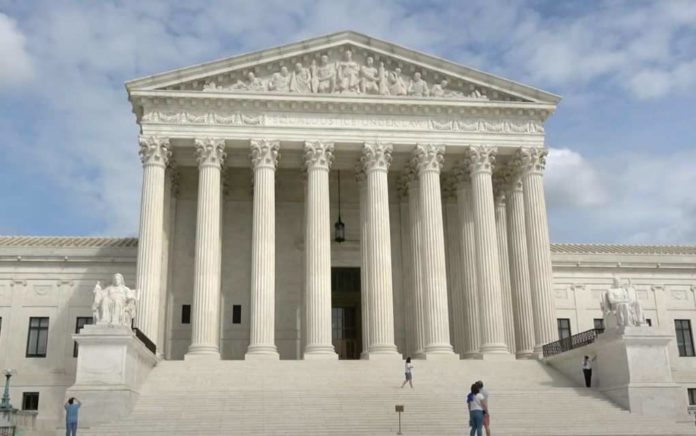
The case now heads toward an almost certain Supreme Court challenge, where the justices will be asked to determine the limits of federal regulatory authority over a drug that has become central to the nation’s ongoing abortion debate. An ongoing HHS and FDA safety review of mifepristone — ordered well before this ruling — is also still underway, adding another layer of complexity to a legal landscape that is rapidly reshaping the post-Dobbs landscape. Whatever the Court ultimately decides, Friday’s ruling made clear that the era of mail-order abortions as unregulated federal policy is facing its most serious legal challenge yet.