
Republicans need to unite. But some aren’t ready to do so.
And now Lindsey Graham hit RINOs with a brutal reality check they never saw coming.
One Vote. Five Years. A Primary Loss.
Bill Cassidy voted his conscience on January 6th. He was one of seven Republican senators who voted to convict Donald Trump at the second impeachment trial in 2021, and he did it knowing full well what it would cost him. Louisiana’s state Republican Party censured him the same weekend. Trump branded him a “disloyal disaster.” And on Saturday night, the bill came due — Cassidy was defeated in his Louisiana Republican primary by Trump-backed Rep. Julia Letlow, ending an eleven-year Senate career on the terms the president had promised since 2021.
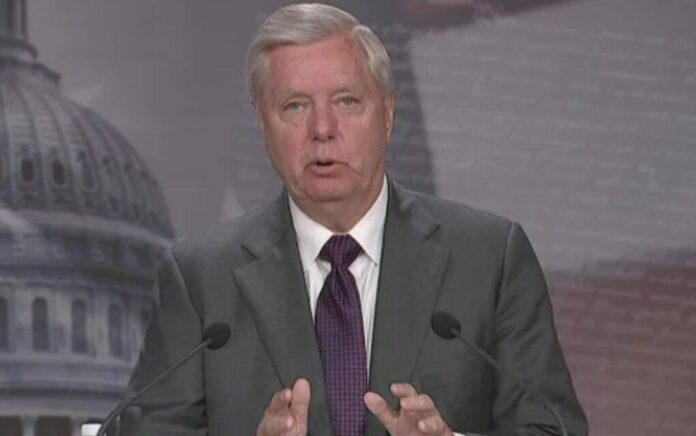
Sen. Lindsey Graham of South Carolina appeared on NBC’s “Meet the Press” Sunday and offered what amounted to the definitive post-mortem — delivered without apology, sympathy, or revision.
“There’s no room in this party to destroy his agenda or to destroy him and his family as a Republican,” Graham said. “If you align with Democrats to stop his agenda like Massie does, you’re going to lose. If you align with Democrats to drive him out of office like Cassidy did, you’re going to lose.”
He was equally direct about what Cassidy’s history represented as a political lesson. “He voted to impeach President Trump, which would have ruined his political life. He could never run for office again.”
Graham acknowledged personal regard for Cassidy. “I like Bill. I thought he was a great senator,” he said. “But he made a political decision.”
The Rule — And The Warning To Massie
Graham was also careful to draw the essential line between permissible disagreement and political self-destruction. He did not say that Republicans must agree with Trump on every question. What he said is that there is a categorical difference between voting against specific pieces of legislation and actively working to remove the president from office.
“You can disagree with President Trump, but if you try to destroy him, you’re going to lose because this is the party of Donald Trump,” Graham said.
The distinction matters. There are Republican legislators who regularly break with the White House on policy questions — on the Iran war, on spending, on specific line items in the budget — without facing the kind of existential primary challenge that consumed Cassidy. What appears to cross the line, in the eyes of the GOP base, is the wholesale alignment with Democratic efforts to end Trump’s political career. That is not policy disagreement. It is, in Trump’s framing, betrayal.
Graham extended the warning explicitly to Rep. Thomas Massie of Kentucky, whose primary against Trump-backed retired Navy SEAL Ed Gallrein takes place Tuesday. Massie has been a persistent thorn in the White House’s side — voting against major Republican spending bills, criticizing the Iran war, refusing to support the “Big Beautiful Bill,” and most recently drawing Trump’s wrath by hosting a rally with Lauren Boebert. Graham said those who align with Democrats to obstruct the president’s agenda face the same electoral fate as Cassidy.
The Bigger Picture: What Saturday Tells Us About 2026
The Cassidy defeat followed a Trump-backed primary victory in Indiana, where Rep. Don Bacon — who had crossed Trump on multiple occasions — was similarly ousted. The pattern is consistent and accelerating. Trump has now demonstrated across multiple states and multiple cycles that his endorsement is the most powerful electoral asset in Republican politics, and that his opposition is a near-certain path to a primary exit.
For Graham, whose own South Carolina primary is approaching and who received Trump’s endorsement weeks ago, the Cassidy result is personally useful as well as broadly instructive. He said as much without embarrassment. “Thank you, President Trump, for endorsing me. It’s helped me in my primary. It’s just a reality, and it’s a good reality.”
For the Republican Party heading into November, the takeaway from Saturday is that internal dissent has been priced in and found electorally very costly. The caucus is more unified around Trump now than at virtually any other point in the modern era. Whether that unity translates into holding the House against a Democratic wave fueled by economic anxiety and Iran war fatigue remains the central question of 2026.