McConnell has not been in good health for some time. But now more problems have surfaced.
And now Mitch McConnell’s hospitalization just got dangerously complex.
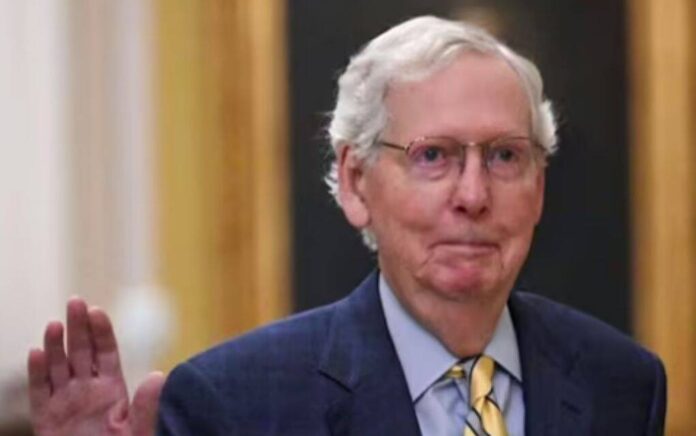
Sen. Mitch McConnell (R-Ky.) was hospitalized with flu-like symptoms earlier this week, an absence that has further delayed action on election integrity legislation in the Senate Rules Committee he chairs—amid ongoing frustration from some Republicans over the stalled Safeguard American Voter Eligibility (SAVE) Act.
McConnell Hospitalized for Flu-Like Symptoms
The 83-year-old senator checked himself into a local hospital on Monday evening, February 2, 2026, “in an abundance of caution” after experiencing flu-like symptoms over the weekend.
A spokesperson, David Popp, stated: “In an abundance of caution, after experiencing flu-like symptoms over the weekend, Senator McConnell checked himself into a local hospital for evaluation last night,” adding that McConnell’s “prognosis is positive and he is grateful for the excellent care he is receiving.” McConnell missed Senate votes on Monday and Tuesday but remained in contact with staff and was expected to return to Senate business soon. His office did not respond to requests for additional comment.
This marks another health-related incident for McConnell, who has a history including a concussion in March 2023, visible freezing episodes during public appearances, a stumble in the Russell Senate Office Building basement in October 2025, and an unsteady gait linked to childhood polio.
He announced in February 2025 that he would not seek reelection when his term ends in January 2027, and he stepped down as Republican leader in December 2024 after nearly two decades in the role.
SAVE Act Stalled in McConnell’s Committee
As chair of the Senate Rules and Administration Committee, McConnell’s absence has contributed to the ongoing delay of the SAVE Act, which has remained in committee for months without a markup or floor vote.
The bill requires proof of U.S. citizenship for federal voter registration, amends the National Voter Registration Act of 1993 to mandate states verify citizenship, and requires removal of noncitizens from voter rolls.
On February 2, 2026, Rep. Brandon Gill (R-Texas) and 34 colleagues sent a letter urging McConnell to advance the measure before the 2026 midterms.
Gill posted on X: “83% of Americans want proof of citizenship to vote, yet the Senate has done nothing for 300 days. The House did its job. The Senate needs to do theirs.”
A related expanded version, the SAVE America Act, was introduced on January 29, 2026, by Sen. Mike Lee (R-Utah) and Rep. Chip Roy (R-Texas), adding a voter ID requirement for federal elections.
Lee posted on X referencing a colleague: “My colleague, @SenAshleyMoody, nails it with this message: Return to Senate tradition Require filibustering senators to (gasp) actually speak Using existing Senate rules Pass the SAVE America Act.”
Broader Political Context
The delay comes amid recent GOP efforts on election-related issues, including conservatives’ push to attach similar measures to funding packages—efforts President Trump rejected in favor of passing a $1.2 trillion continuing resolution without changes.
McConnell’s health episode highlights the Senate’s narrow margins and committee dependencies, where his role remains influential despite his retirement announcement and the party’s shift toward new leadership priorities.